The venue
St Paul's Within the Walls: the church
The church that hosts La Traviata in Rome: its Gothic Revival design, the Burne-Jones mosaics, its bells and the concerts it holds.
Reserve your seat for Violetta ↗Rome's first Protestant church within the walls
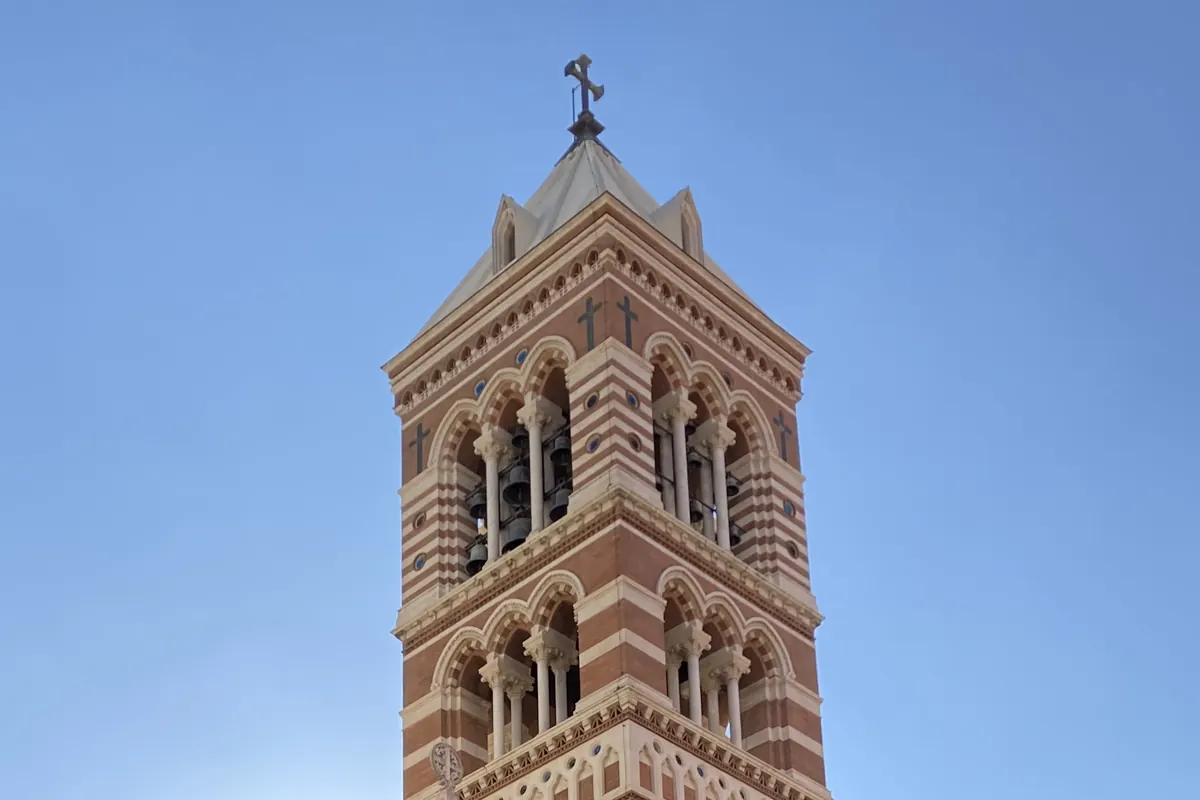
The Episcopal expatriate congregation could only build in Rome once the city had passed to the Kingdom of Italy in 1870. In 1872 it hired the English architect George Edmund Street, who gave it Gothic Revival lines in banded brick and stone. The church dates its consecration to 1876, while Wikipedia gives 1876 for the inauguration and 1880 for completion. Italians call it San Paolo dentro le Mura, and Americans in Rome know it as the American Church.
The stripes and the starry vault
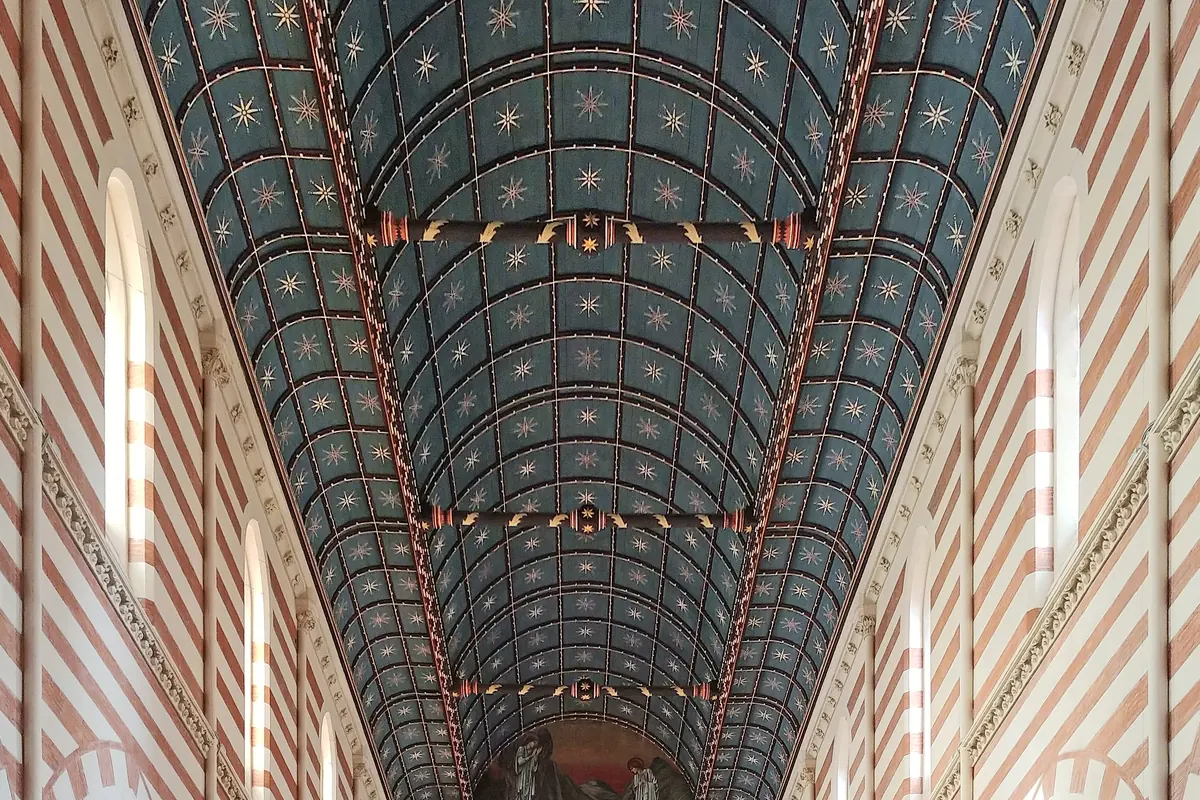
The first thing most visitors see inside is colour. The nave walls are banded in red and cream, and the barrel-vaulted ceiling is a deep blue patterned with gold stars. The nave leads the eye to the apse, where the mosaics begin. Rows of seats run down both sides of a tiled aisle. The church says it is one of the most sought-after venues for classical music in Rome. The Via Nazionale front carries the same banding outside, so the building announces its colours before you go in.
The Burne-Jones mosaics
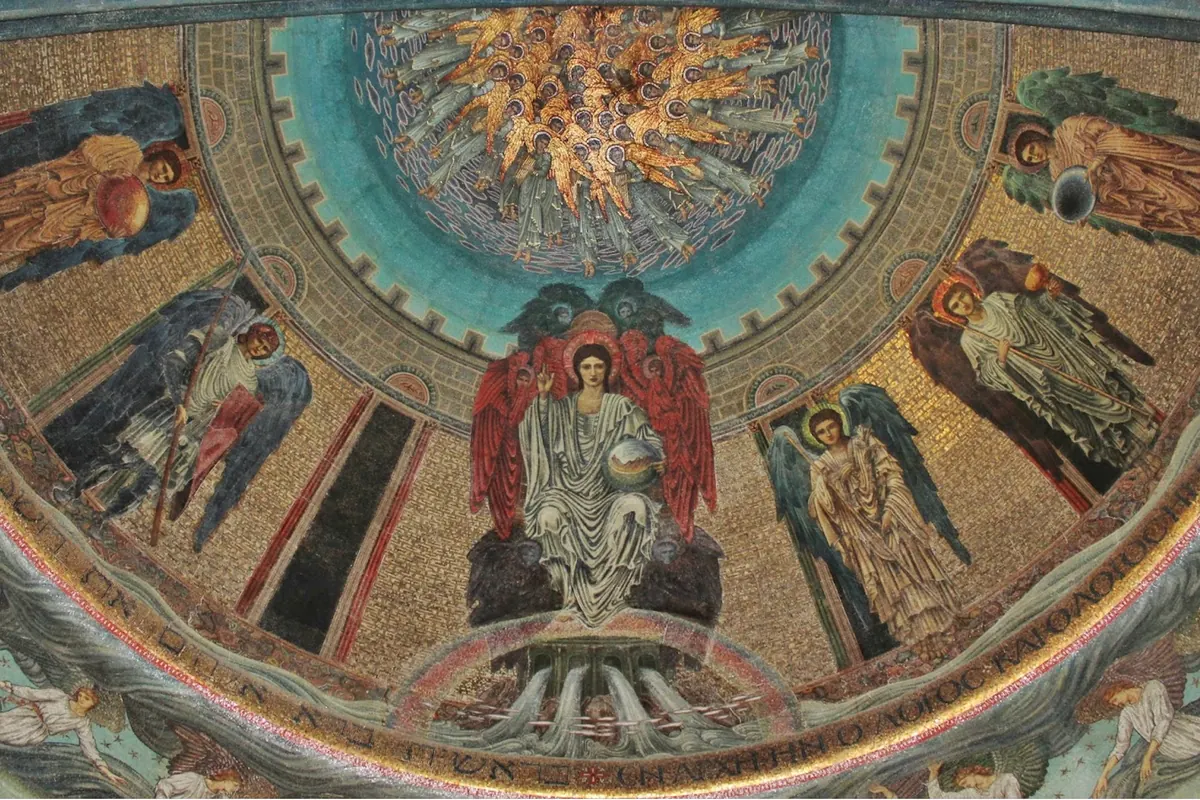
The church holds four mosaics, the biggest work the Pre-Raphaelite painter Edward Burne-Jones made for any building. Two arches before the apse carry The Annunciation and The Tree of Life, both finished in 1894. The semi-dome above the altar holds Christ Enthroned in the Heavenly Jerusalem, finished in 1885. A fourth panel, called The Earthly Paradise or The Church Militant, was only finished in 1907, by Thomas Rooke, after its designer had died. The church says the mosaics are valuable enough for the building to be a national monument.
How the mosaics were made
Ravenna's mosaics, which Burne-Jones had visited in 1873, were his model. His cartoons and colour notes went to Venice, where a Murano glass and mosaic firm mounted the tesserae before the panels were fitted in Rome. Wikipedia adds that he and William Morris chose the colours together. Burne-Jones never travelled to Italy to oversee the work; Thomas Rooke, his assistant, was sent instead.
Glass, bells and organ
The nave windows were designed by the English firm Clayton and Bell and tell the life of St Paul around the church. The church also holds mosaics by the American artist George Breck, including a Nativity on the rear wall. A carillon of 23 bells was constructed in 1876 by Severin Van Aerschodt, and the organ was built in 1963 by the firm Vincenzo Mascioni and Sons.
What the apse mosaic shows
In the great mosaic of the apse wall, the church describes Christ in glory, enthroned between archangels, with a glittering vision of angels at the top. One of the heavenly gates beside him is empty, a reminder of the fall of Lucifer. Below sits the sea of the firmament and a row of angels, and in the lowest band the Church Triumphant gathers saints and figures from Christian history. Earlier, on the first arch, the Annunciation is set in the reddening evening sky.
The windows and the rose
The windows of the nave start with the one on Via Nazionale to the right of the west door and follow the life of St Paul in order around the church, from his calling to his martyrdom and burial. The great rose window high on the west wall shows Christ the King surrounded by eight Roman martyrs. The church lists the saints by name. Read together, the glass and the mosaics tell one story from opposite ends of the nave.
A church that hosts concerts
St Paul's describes itself as one of the most sought-after venues for classical music in Rome. Its own site says outside musicians use the space for concerts and that its Luminaria series runs on Sunday evenings. It adds that many of the ticketed evening concerts are mostly operatic and are run by the hosting organisations, which you contact directly. La Traviata is one such performance. The congregation worships here on Sundays, so the room serves both purposes.
Who this isn't for
Anyone hoping for a grand opera house with boxes, a gilded ceiling and stage machinery will not find that room here. It is a working Episcopal church with benches, stone and mosaic. Visitors who come only for the architecture will find that the evening concert is not a sightseeing visit: the performance is the point, and the apse is part of the backdrop.
Sources
- St Paul's Within the Walls: Sacred space (the church's own site)
- St Paul's Within the Walls: The Burne-Jones mosaics (the church's own site)
- St Paul's Within the Walls: The stained glass windows (the church's own site)
- St Paul's Within the Walls: Music and concert calendar (the church's own site)
- St. Paul's Within the Walls (Wikipedia article)