The story behind the story
Marie Duplessis, the real Violetta
Who was the Paris courtesan behind La Traviata? Marie Duplessis, Dumas fils, the novel, the play and how Verdi turned them into Violetta.
Reserve your seat for Violetta ↗A girl from Normandy
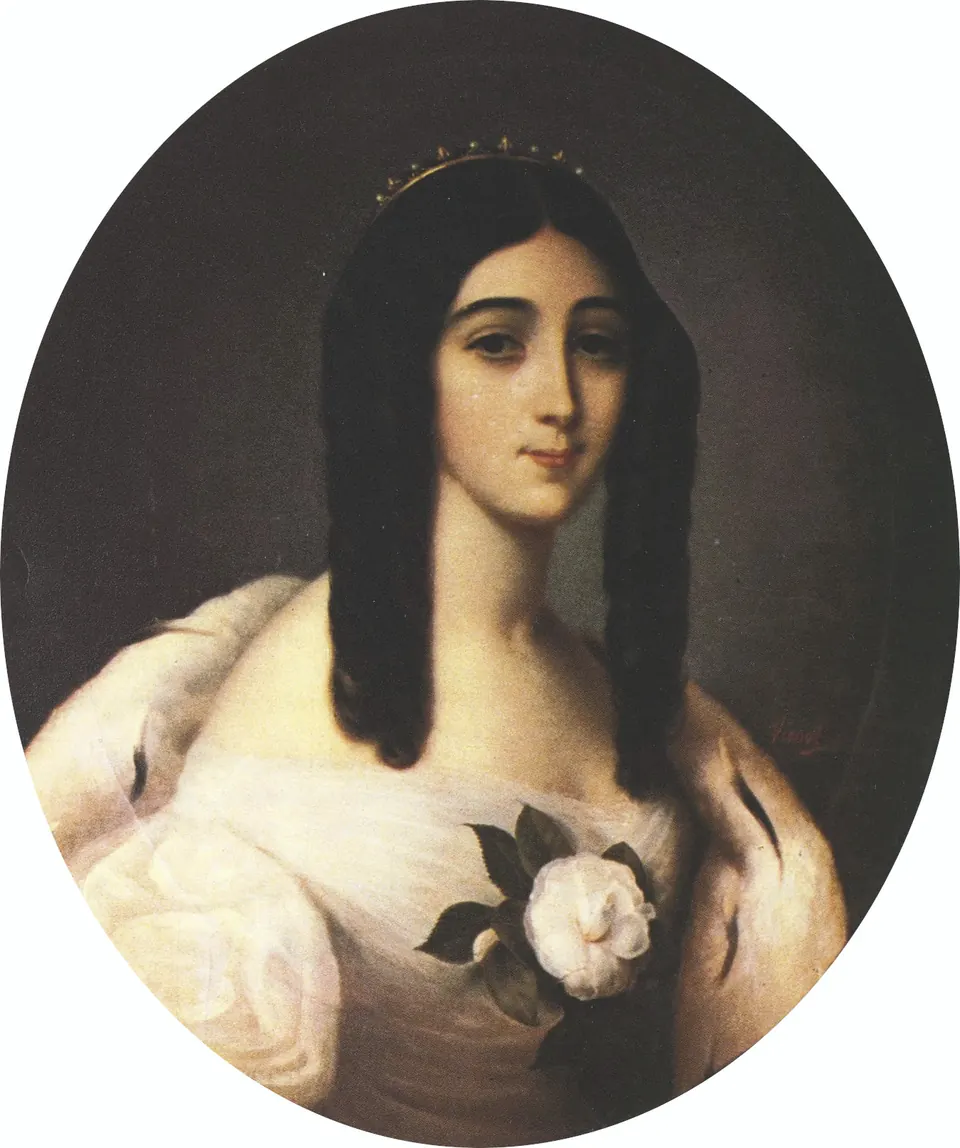
Marie Duplessis was born Alphonsine Rose Plessis on 15 January 1824 at Nonant-le-Pin in Normandy. At fifteen she moved to Paris and found work in a dress shop. By sixteen she had grown aware that prominent men would pay for her company, and she became a courtesan. She taught herself to read and write and followed the news so she could hold her own in conversation. She also added the noble-sounding Du to her name. Her biography draws on the literary persona as much as on records, so details vary between sources.
A salon and a reputation
Duplessis was a popular courtesan and also the hostess of a salon, where politicians, writers and artists met for conversation. She rode in the Bois de Boulogne and attended opera performances. She had her portrait painted by Édouard Viénot. She was known as discreet, intelligent and witty, and she stayed in the good graces of many of her patrons after their relationships ended. Much of what is told about her today comes from the literary figure and from contemporary legend. The portrait by Viénot shows her with a white camellia pinned to her gown.
Dumas fils
Alexandre Dumas fils, son of the novelist of The Three Musketeers, was her lover from September 1844 to August 1845. She died of tuberculosis on 3 February 1847 at the age of 23, and her belongings were auctioned within weeks to pay her debts. Her funeral at Montmartre Cemetery was attended by hundreds of people. Dumas wrote his novel the next year, based on her. Dumas later became a member of the Académie française in 1874.
From novel to play
La Dame aux Camélias was published in 1848. In the novel the heroine, Marguerite Gautier, is nicknamed the lady of the camellias, and the narrator learns that her lover Armand Duval has sent camellias to her grave. Dumas adapted it as a play that opened at the Théâtre du Vaudeville in Paris on 2 February 1852 and was an instant success. In English-speaking countries the story became known as Camille, and sixteen versions were staged on Broadway alone.
From play to opera
Verdi and his partner Giuseppina Strepponi were in Paris that winter and saw the play in February 1852. The composer began to think about it at once and, after returning to Italy, told a friend that for Venice he was setting La Dame aux camélias, which would probably be called La traviata, a subject for our own age. Marguerite Gautier became Violetta Valéry and Armand Duval became Alfredo Germont. Piave wrote the Italian libretto. Piave wrote the Italian libretto and the work was staged in Venice in March 1853.
What changed in the opera
The opera keeps the central pattern: a courtesan, a young man from a respectable family, a father who asks her to give him up, a public humiliation and a death from consumption. Verdi and Piave wanted a present-day setting, but the authorities at La Fenice insisted it be set in the past, around 1700, and realistic productions did not arrive until the 1880s. The title means The Wayward Woman, and the opera was first called Violetta. Dumas had set the story in his own time, which is why Verdi saw it as a subject for our own age.
What the Rome performance keeps
The performance in Rome tells Verdi's version of the story in three acts: a party, a sacrifice and a death. In the first act Violetta gives Alfredo a flower and asks him to bring it back when it has wilted. If you want to see the real woman, her tomb can be visited at Montmartre cemetery in Paris, according to Wikipedia.
Why the story lasted
The play was a long-running success. Eugénie Doche, who created the role of Marguerite on stage, recalled playing it 617 times. In 1853 Jean Davenport starred in the first American production, a sanitised version that renamed the heroine Camille. Decades later Alphonse Mucha drew a poster for Sarah Bernhardt in the role, with the white camellia as its emblem. Verdi's opera, written only a year after the play opened, ensured the story outlived its Paris moment.
Who this isn't for
If you only want the plot of the opera, the explainer guide covers it faster. This guide is for readers who want to know where Violetta came from, and for anyone curious why a 19th-century Paris scandal still holds a Rome audience in a church.
Sources